It’s been a long time coming and while I’m not in a position to update the notes page, I am at least in a position to discuss two relevant issues. These being how to research for inspiration for a novel, and what I think I can get out of the research that I’ve done.
I’ll finish up today’s post with where I plan to go from here, but that’s a standard part of my blog posts, so it’s nothing new if you’ve been following along at all.
How Not to Research.
First attempt…
I made a fundamental mistake when I started with this book: I decided to try something different. My plan was to speed the process up by going through the book page by page and underlining things I thought important, interesting – things that I thought might be directly or indirectly useful and so on.
From there I transcribed every single note into a spreadsheet. The plan was to include the page reference, the snippet of text, and a note explaining what I thought it would mean for the developing story. As you can see from the example below, the idea for notes explaining what the snippet meant wasn’t strictly adhered to, and to be honest, it only lasted about a half hour. About twenty five entries.
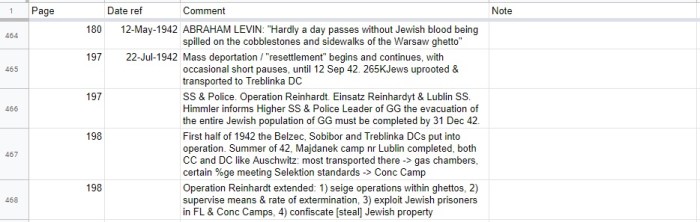
In the end, I wound up with 923 separate notes. Sorting by the date reference should have cleaned it up a lot, since Mr. Gutman repeats himself somewhat (not a criticism, he just reiterated relevant material to keep things in context) but apparently I can’t type properly, so a bunch of the dates were wrong.
Second attempt…

So.
The next stage involved combing through all 923 notes to distill them by handwritten scrawl across eleven pages of my handy-dandy notebook, then transcribe them back again into a new spreadsheet, distilling the information down a little more each time.
That got it down to a total of 209 entries, in chronological order as far as I can make it.
I have no plans to redo this slog, either here or ever again in this fashion.
So there’s a new plan.
The New plan…
As I mentioned, very briefly, in my last post, I’m reverting to the research technique I used in my History classes at ETSU. It’ll need some refinement, but I think it’ll work out better.
Here’s the new plan:
- Read through, making notes in a separate notebook using the page number as a reference.
- Read through those notes and make a second set of notes based on what’ll basically be a ‘brainstorm’ session to establish what categories are important, such as characters, events, themes etc.
- Using the results of the brainstorm and the raw notes, collate into a spreadsheet, hopefully distilling the notes down even further with each step of the process.
What Did I Get Out of The Jews of Warsaw
I won’t go into the obvious: life sucked in Warsaw from the fall of Poland until… well… pick your own date. For the Jews, as I understand it, the families of the survivors from Oskar Schindler’s List outnumber the totality of Jews remaining in Poland, so it’s really hard to say when the horror ended.
One of the more important lessons I learned, from the perspective of the budding author with a story trying to bust out, is that it would be a mistake to try to directly transplant even just the skeleton of events from history to a story-line. Mr. Gutman takes great pains to credit everyone he can, for good and for ill, and while this made his work seem more objective, it would leave me with a character list that would make War and Peace seem like a small production. I’m simply not up to that, and I doubt any reader would want to wade back and forth through my story trying to keep tabs on who everyone is.
If I were setting the story in the Warsaw ghetto, that would be different. But I’m not.
In my last post, again, I noted that the history of the Japanese American internment of World War II should have occurred to me as a research source earlier, since it’s more geographically relevant. But, on reflection, it’s probably for the best, since I might have been tempted to rely more heavily on that source – meaning the historical event rather than the book – if I’d taken it in isolation than I would be after finishing Mr. Gutman’s book.
As far as fleshing out the Black Box Factory stories, there’s a lot of inspiration and material here. There’s a view of the Police that never occurred to me before, the new elite, the smuggling, the duplicity of the ruling council and how and why over a quarter of a million innocent people can be rounded up and shipped off into gas chambers.
None of that is a spoiler, of course, not just because I don’t even have an outline plan yet, but also because I intend to write the story from the perspective of a few ordinary individuals at ground level. If there were such things as gas chambers, they wouldn’t know anything about it.
Up Next…
I don’t intend to push further with The Jews of Warsaw notes, although if I get the time this week, I’d like to better summarize everything on the relevant page.
It would be super-awesome if I could indicate that I thought feedback from my Alpha Reader might show up, but that would be mindless optimism – more mindless than optimistic since I certainly know better.
So, my most reasonable goal is getting through Infamy, which is a somewhat smaller book and I hope my ETSU research technique will be quicker and more efficient.
In the meantime, this afternoon I intend to relax my way out of the headache that my morning migraine left me with.
I hope everyone has a safe, enjoyable, migraine-free week.
Categories: Black Box Factory, Research, Research, The Warsaw Ghetto, Writing
 Andrew Wellington
Leave a comment