It was my intention to collate both sets of notes into one straightforward collection before I moved on to the next task I have in my sights, the re-read of The Old Man with Alpha Reader feedback borne in mind. This doesn’t seem to be the best way forward, however. At least I can report having completed Infamy and pulled a set of what I’m going to call ‘notes’ together.
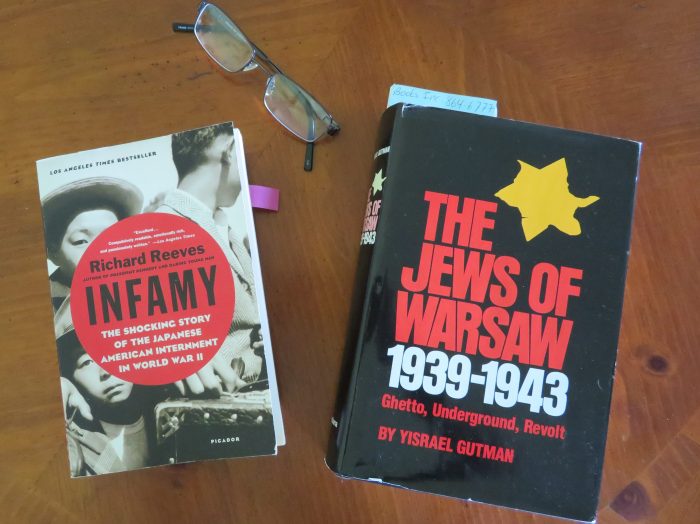
The Notes.
Researching for this project has been a process under constant review, but I think I’ve hit upon the best approach with Infamy:
- Read through taking notes of absolutely anything of interest to the subject matter the subject, with appropriate page number in the margin.
- Read back through those notes and take note of anything that potentially relates to the ultimate goal, in this case, a dystopian story currently under the working title Black Box Factory.
It took four weeks to complete the initial reading, but combing through the notes took about three days, allotting perhaps an hour or two each day.
Warsaw and Internment: The Comparison
From the outset, let’s remember that these two historical events are being considered purely from the perspective of research for a work of fiction. This means I’m only looking for similarities and someone pointing out that 75% of the population of the Warsaw ghetto was murdered whereas the Japanese Americans were not the subject of an extermination campaign, well, that person would have missed my point and my objective.
For clarity, I should state that again more succinctly: I am not looking for differences, I am looking for similarities.
Some Similarities.
In both situations, the Constitution was an obstacle to be overcome. The Nazis had passed legislation giving Hitler authority to do as he pleased. The United States had to undergo some legal gymnastics in order to find themselves to be within the constitution, but they managed it.
…once a judicial opinion rationalizes such an order to show that it conforms to the Constitution, or rather rationalizes the Constitution to show that the Constitution sanctions such an order, the Court for all time has validated the principle of racial discrimination in criminal procedure and of transplanting American citizens.
Justice Robert Jackson, Korematsu v. United States, 323 U.S. 214, Dec. 18, 1944
There is some controversy, especially lately, regarding the Concentration camps detaining asylum seekers in the United states. I’ll refer to the Merriam-Webster definition and leave it at that. At any rate, the Japanese Americans were most definitely political prisoners and mass detention without charge is never a healthy thing for a democracy.
Both the Jew and Japanese American were subjects of some outlandish propaganda. The world famous ‘Dr. Seuss’ indulged in this also.
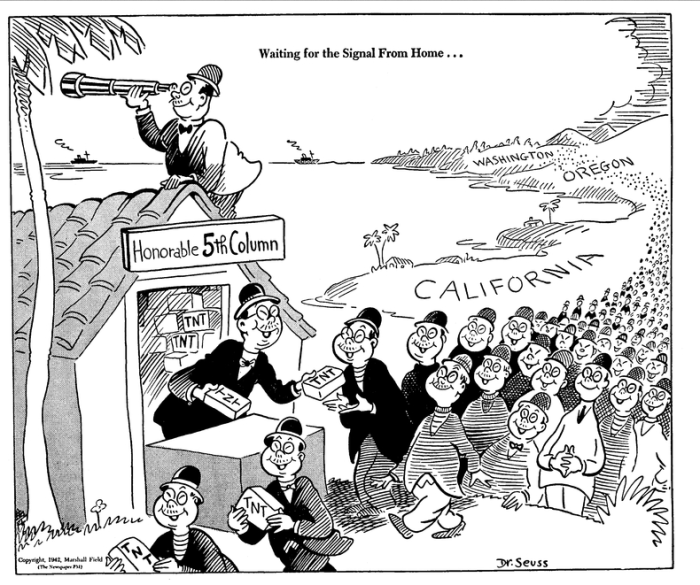
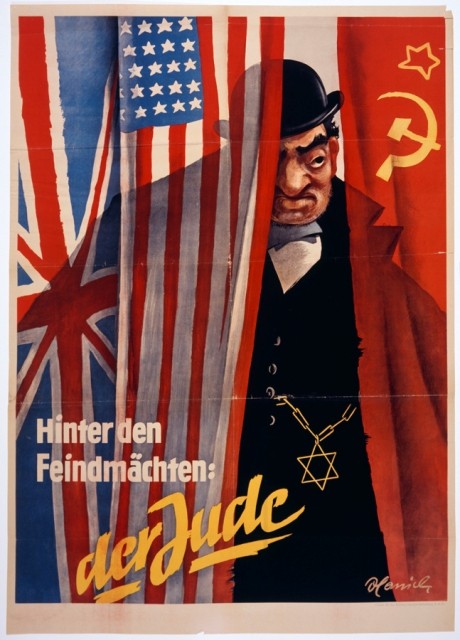
The target demographics were stripped of basic civil rights in both cases, showed up with only what they could carry all with sufficient support from a public that included vultures who cashed in on their misfortune – anything from buying their property at prices amounting to theft all the way up to black market profiteering. The authorities claimed both the walling off of the ghetto and the concentration camp fences were to protect those imprisoned from attack, while the live-ammo machine guns and bayonets all pointed inwards. Also, in both cases, civilians assault and beat innocent people without punishment or consequence.
Both in the ghetto and the camps, an unrepresentative ruling council operated ostensibly on behalf of those incarcerated, forming a catalyst to worsen the division between the proud and the passive, while killings by the military went unpunished. In both of these crucibles there formed anti-authority movements which attacked collaborators and to a large extent went unpoliced by the authorities who preferred to leave the affairs of the incarcerated to the incarcerated.
Finally, as Senator A. B. ‘Happy’ Chandler from Kentucky would have put it, the people persecuted “have no place at all in the American way of life.”
There’s more, but I’m pretty sure that’s enough.
Collating Notes.
Rather than collate the notes, I’ve decided to leave them as they are, both The Jews of Warsaw and Infamy, at least in part because it’d complicate matters in trying to trace a note back to source, but also because there’s not as much overlap as I had originally expected.
So, What Next?
I’ve thrown together a rough, very high level outline that will need a lot of work to make it viable, but it’s embryonic so that’s to be expected. Right now I have a head full of scenes and snippets, but I’m keenly aware that most of them won’t make it into the final outline.
Up Next…
In any event, it’ll be a while until I turn back to this project. I need to get The Old Man onto my Kindle and have a final read through before deciding what to do next. My suspicion is that I’ll have at least one more edit cycle before I start to think properly about going to Beta Readers.
Then I’ll need a professional editor and a marketing plan. I currently have neither.
Next week I’d hope to able to report progress on what should be either the ultimate or penultimate read through and edit cycle.
I hope everyone has a great week and some pleasant weather, for a change.
Categories: Black Box Factory, Japanese American Internment, Research, Research, The Warsaw Ghetto
 Andrew Wellington
Leave a comment