Over the time I’ve been working on my research for Lock Out Tag Out, I’ve been banging my head against my wall of ineptitude when it comes to making and taking effective notes that are meaningful and easily collated. To that end, here are three simple rules that I’ve developed up to my latest reading. I’m in the process of going back over every book that I’ve read through and combing through all the notes to make them much more effective.
I think I’ve found a really great way. I don’t say that very often because most of my ideas are crap, but this one I’m standing behind.
So without further ado, here are my rules.
1. Don’t be Protective of Your Books.
Don’t get me wrong, I positively hate finding writing in my books, I absolutely detest it!
But it’s resulted in my trying too many different approaches to making notes. The absolute worst was writing them in a separate composition book, thinking numbering them and including page references would help. It doesn’t. I never made it back to that book because I knew what a headache it was going to be. It still is going to be that headache, but at least I have an ideal process, a state that I want the research material to be in.
So, go ahead! Mark your books! You won’t regret it!
2. Color Coded Highlighters.
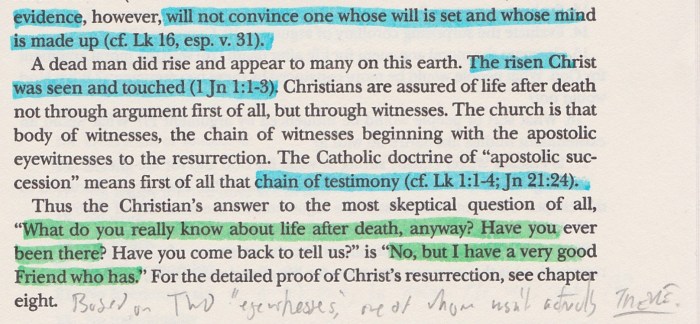
This is the latest development. While going through Kreeft & Tacelli’s Handbook of Christian Apologetics, I found there were three kinds of notes I wanted to take. Firstly, there were biblical citations that I coded blue, there were interesting statements and ideas that I coded in green and then, because I’m not a Christian and I’m totally unconvinced by their arguments I couldn’t help but include snarky comments in pencil, just to remind myself that I wasn’t just passively absorbing their arguments and letting poor argumentation go unchallenged.
3. Make Better use of Scrivener.
Previously I’d been marking up my notes to the – now unavailable, unless you currently have the web addresses bookmarked – notes pages on this site. The idea was that if I did that not only would it interest anyone who followed along or looked back over what I’d posted for my work on this site, I’d be able to reference it from anywhere that I had an internet connection.
Neat, huh?
Nope. Not at all.
Let’s take the image above from my Handbook of Christian Apologetics notes. Anyone who knows me, knows I’ve been a lot more caustic in my commentary in the book than this, but I’m – I think rightly – reluctant to show that to my ‘audience.’ Additionally, I’ve had to be somewhat coy about some of my notes so that I don’t give any spoilers away. If one-tenth of one-percent of everyone who’s visited this site and looked at my notes had the book spoiled…
Well, right now nobody would be remotely affected, but still, someone might visit one day and if they learned too much about the plot, they might not bother reading anything else I wrote. Why read a book with a spoiled ending?

The accessibility-from-anywhere problem disappears when I use Microsoft OneDrive. To be fair, perhaps OneDrive isn’t the best online storage out there, I don’t know. What I do know is:
- It’s free.
- I’ve so far used only 1 of 5 GB and I’ve not been particularly tidy. The Scrivener stuff so far takes up less than 30MB.
- It works. I have Scrivener on our main PC and on my crappy little Windows Notebook and I’ve worked just as easily on both.
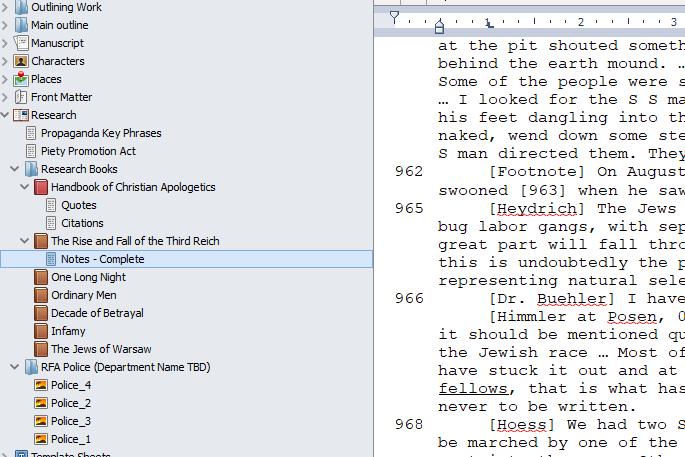
I’m currently in the process of working backwards through all the books I’ve read and I’ll be co-locating all of my research notes in one place. From that I can easily develop further ideas about additional characters and events that can highlight things I want to include. For instance, Sophie Scholl is a very inspiring character that I might want base somebody on.
Moving Forward.
So there they are.
Three great ideas I wish I’d been working to this whole time. If you have any advice of your own, let me know in a comment, an email or a Facebook message.
P.S. If you’re following along, my foot is still broke and our oven died again.
Enjoy your week.
Categories: Advice, Lock Out Tag Out, Research, Research, Research, Research, Scrivener, Writing
 Andrew Wellington
Leave a comment